

Strip away the noise and the Anthropic-Pentagon fight comes down to one demand and two refusals.
The demand, delivered by the administration in late February: let the military use Claude for “all lawful purposes,” no exceptions. The refusals: Anthropic would not permit mass surveillance of American citizens, and would not allow fully autonomous weapons without a human in the decision chain. Two red lines. That’s the entire dispute. Not whether the military could use AI. Whether there was anything it couldn’t use it for.
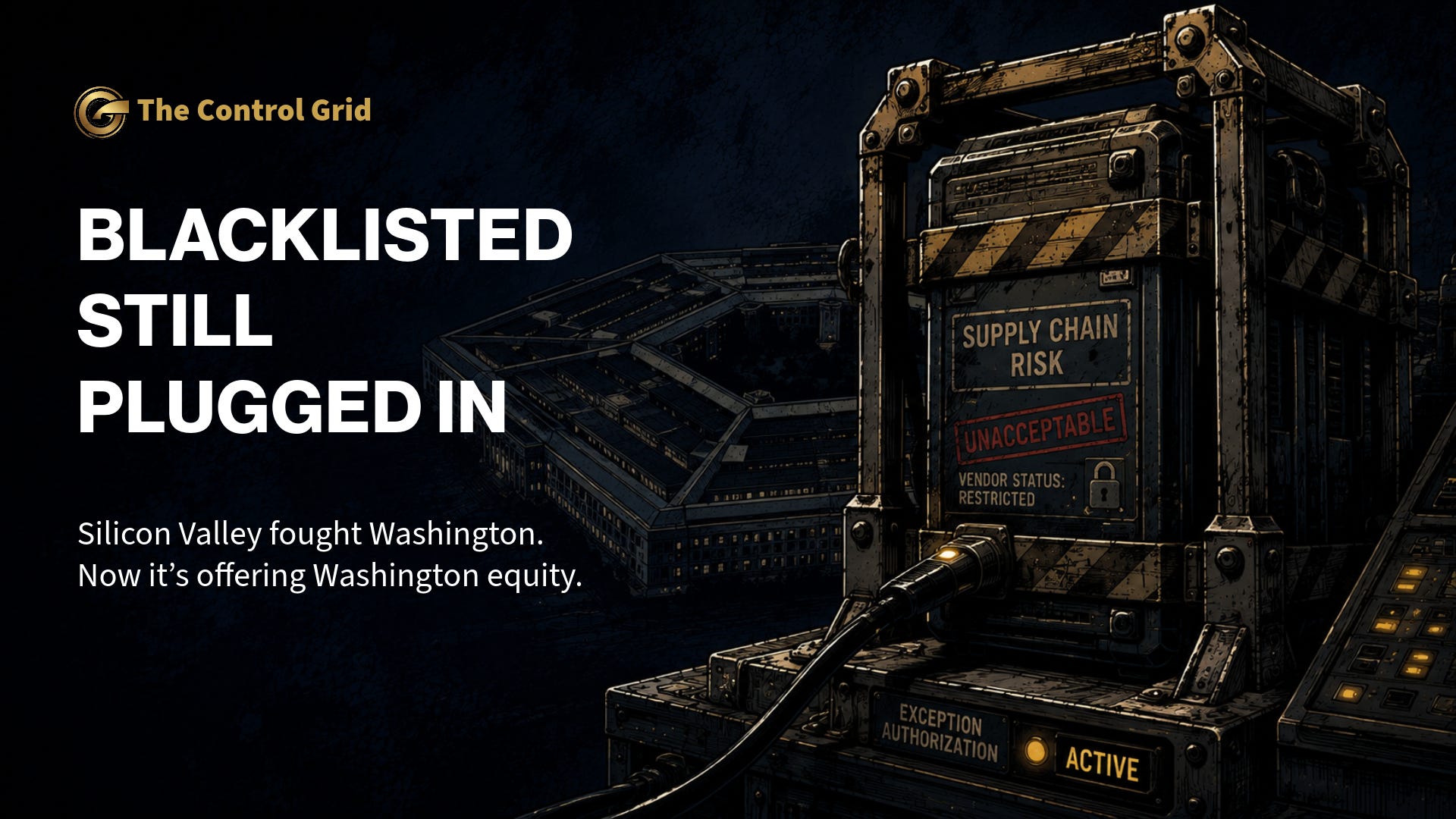
When the Friday deadline passed with those lines intact, Trump ordered every federal agency to stop using Claude. Defense Secretary Pete Hegseth then formally designated Anthropic a supply chain risk, a label historically reserved for foreign adversaries like Huawei. An American company, blacklisted like an enemy telecom, for declining to write the government a blank check. A senior Pentagon official put the doctrine on the record: the military “will not allow a vendor to insert itself into the chain of command” by restricting lawful use. Anthropic’s CEO called the move “retaliatory and punitive” and sued, telling a court the designation is “unprecedented and unlawful”.
The war with Iran began within days. And here is the fact that detonates every official talking point: the Pentagon kept using Claude anyway.
Not a leak. Sworn-adjacent testimony. In a March Senate hearing, Pentagon CIO Kirsten Davies confirmed under questioning from Sen. Jack Reed that Claude was in active use in Operation Epic Fury, complete with a “measure of time” and an “exception process” for removal. Reed called it odd. Odd is one word for it. The Department of War designated a company an unacceptable supply chain risk and then ran its product through an active military campaign, because, as Pentagon staffers and contractors told Reuters, the alternatives weren’t as good and recertifying replacements could take 12 to 18 months. One contractor’s summary of the internal mood: career IT people at DOD hate the removal order.
So which is it? A company too dangerous for the government to touch, or a capability too valuable for the government to give up? It cannot be both. Unless the designation was never about risk at all, and was always about punishment for the refusal. You do not need me to editorialize. The government’s own behavior is the confession.
Meanwhile the machine ran hot. Retired Adm. Mark Montgomery described the military processing roughly a thousand potential targets a day and striking most of them, with next-strike turnaround potentially under four hours. This is the tempo AI enables, and it’s exactly why the red lines matter. Amnesty International says a strike on a school in Iran killed over 100 children, and Human Rights Watch has called for a war-crimes investigation; CBS News reported it could not verify whether Claude systems were used in that strike. We don’t know. That’s the point. At a thousand targets a day, “we don’t know” is the permanent condition, and the question of what the machine is allowed to refuse stops being philosophy.
The war fractured the administration from inside. National Counterterrorism Center Director Joe Kent, a retired Green Beret with eleven combat tours, resigned in March, writing that Iran “posed no imminent threat” and that he could not in good conscience support the war. Trump’s response was to call him weak. Whatever you think of Kent, and there is plenty to think, the highest-ranking counterterrorism official in the country resigned rather than co-sign the threat assessment. That happened.
Then came the bill. In June the White House sent Congress an $87.6 billion emergency supplemental, with $67.1 billion for the Pentagon, including $21 billion just to rebuild munitions stockpiles the war burned through. And buried in the fine print, a detail that should embarrass everyone: analysts note the supplemental includes no dedicated funding for the AI software the president’s own directives require, because that software is bought with operations money the war drained. (Disclosure on that source: it’s authored by Onebrief, a defense AI vendor arguing for funding it would benefit from. They disclose it; so do we.) The administration mandated an AI-first military, started a war that emptied the accounts that pay for it, and sent Congress an invoice that forgot the software. That’s not a strategy. That’s a keynote with a body count.
And while the government was pointing its threat-model at the American company that told it no, an actual adversary was already inside the wire. Last October, F5, the vendor whose BIG-IP gear manages traffic for federal networks and much of the Fortune 500, disclosed that a nation-state actor had maintained long-term, persistent access to its systems, stealing portions of BIG-IP source code and details on vulnerabilities F5 hadn’t yet fixed. The dwell time: roughly twelve months, undetected. Officially the intruder is just a “nation-state”; Bloomberg reported officials privately suspect a PRC-linked actor, which Reuters could not verify. CISA issued an emergency directive warning of an imminent threat to federal networks, and the stolen source code and vulnerability intel are still out there, a loaded weapon with no serial number. Hold both facts in your head at once: the designation reserved for foreign adversaries went to an American AI lab over a surveillance refusal, while a probable foreign adversary spent a year inside the plumbing of the federal government. That’s not a security posture. That’s a grudge with a budget.
The government’s answer arrived today. The White House announced GOLD EAGLE, a centralized clearinghouse where industry funnels cybersecurity vulnerabilities to the federal government for AI-powered triage and patching, run by the White House, Treasury, DHS, and the Department of War, and already operating. Let me be fair: after F5, faster coordinated patching is a real need, and on paper this is good policy. Now the questions the press release doesn’t answer. The announcement says it leverages “frontier AI capabilities” and quotes Hegseth touting “frontier AI alongside top American innovators”, the same Hegseth who designated the frontier AI company that set usage terms a supply chain risk. Which frontier AI, then? The release names no companies at all. And a national clearinghouse of unpatched vulnerabilities in American infrastructure is also, by definition, the most valuable exploit database on earth, held by a government with a documented history of sometimes keeping flaws for offensive use rather than disclosing them. Who audits GOLD EAGLE? Which vulnerabilities get patched, and which get kept? Nobody has answered, because as of this afternoon, nobody in Washington has asked. Consider it asked.
Four parts, one pattern. Meta allegedly turned surveillance on its own workers to feed the machine. Apple says OpenAI raided its vault to build hardware for an IPO. The industry and the government are negotiating who owns whom. And when one company drew two narrow lines around American civil liberties and human control of lethal force, the state reached for the adversary playbook, and kept the product.
The Silicon Valley myth is dead. What replaced it isn’t chaos. It’s consolidation. The machine, the money, and the state, closing ranks. The only thing still outside the perimeter is you.
Which is exactly where they’d like you to stay.
This concludes The Death of the Silicon Valley Myth. If you missed the earlier installments: Part 1 on Meta’s algorithmic layoffs, Part 2 on Apple v. OpenAI, Part 3 on the government’s equity play. For the full Anthropic recall-and-restoration saga that preceded this fight, read our Bubble and the Backlash series.
Freedom isn’t a feature. It’s non-negotiable. Adapt and overcome.
Eric Mitchell is a Marine Corps veteran, former Silicon Valley insider, and former national television political analyst whose work has appeared on NewsNation, CNN, BBC, and MSNBC. He is the Chief Marketing Officer of Sacred Loop AI and Chief Editor of The Control Grid, where he investigates artificial intelligence, Big Tech, government power, and the financial incentives shaping the future of technology. His reporting follows one principle: Follow the evidence. Explain the system.
Follow the Investigation
The conversation doesn’t end with one article.
X: https://x.com/EricLMitchell
LinkedIn: https://www.linkedin.com/in/ericlmitchell
For breaking investigations, behind-the-scenes research, and analysis that doesn’t make it into every article, follow along across all three platforms